Tuesday, September 11, 2018

Tupelo,Mississippi September 10, 2018

Thirty miles outside of Tupelo we blew a trailer tire and it happened while there was a huge thunderstorm accompanied by lots of lightning.  While it was an unexpected delay, we are counting our blessing as we were able to find tires in Tupelo.  The tires only had 12,000miles on them, but that is the second one that has blown so we decided to replace all four.  We are headed to Manitoba in some remote areas and we do not want to miss out on traveling with the group due to not being able to find a tire if we have a problem.  We are carrying the 2 remaining 12,000-mile tires with us as additional spares.

The most significant monument of Tupelo, Mississippi, I think most would agree, is a small two-room house where the King of Rock & Roll, Elvis Presley, was born on January 8, 1935.  His twin brother was born stillborn.  The house was built by his father, Vernon Presley, with a $180 loan during hard depression times.  The house had no running water.  One room was a kitchen, the other room all of them slept in. The family lived in the house for about three years.  They lost the house when his father, Vernon, went to Parchman Farm—the Mississippi State Penitentiary— to serve eight months of a three-year sentence for altering a four-dollar check.  During this time, Elvis and his mother took the long bus ride to Parchman on the weekends to visit his father.  The family lived in other places in Tupelo until when Elvis was 13 when they moved to Memphis Tennessee.  After losing their home they lived in a succession of low-rent homes before they all left for Memphis in 1948 in search of affordable government housing.  What a blessing that would end up being as Elvis records his first song in 1953 in Memphis. 

The Elvis birthplace memorial includes the two-room house he was born in, the Assembly of God church he attended, a museum and the Elvis Presley Memorial Chapel.

While in Tupelo we also visited the Tupelo Automobile Museum-120,000 square feet of automobiles, many we have never seen and also some we have never heard of.  Enjoy the pictures.  It was a great museum.

Next stop is Littlerock, Arkansas.


 Our Shredded Tire
 Elvis Presley Two-room Birth House
Elvis Presley Two-room Birth House
 Elvis Presley Two-room Birth House
Elvis Presley and his Parents
Assembly of God Church that Elvis Presley Attended
Inside Assembly of God Church that Elvis Presley Attended 
Elvis Presley Memorial Chapel
Elvis Everywhere
1886 Benz
1904 White Model D
1910 Haynes
1914 Hispano-Suiza Boat-Tail
 1929 Packard
1933 Morgan
1941 Ford Woodie Wagon

 1948 Jaguar Mark IV
1948 Tucker
 1954 Kaiser-Darrin
1 of 435 made
 1955 Messerschmitt
 11957 BMW Isetta
 1957 FordSkyliner
1957 Corvette
 
1967 Amphicar
Part boat part car
1974 Volkswagen SP-2
Only 10,000 were built
 1981 DeLorean DMC
That is all Stainless Steel
1982 DodgeDart Electric
Only 50 were made and it had a total of 20 batteries
1958 Toyopet Crown Deluxe
Toyota's first full-scale passenger car
It was the first Japanese car to be sold in the Mainland United States

Saturday, September 8, 2018

Montgomery, Alabama September 7, 2018

Alabama became a US state in 1819.  There were 4 other capital cities in Alabama prior to the present Capitol being built in Montgomery that was completed in 1851.  Today it is restored to reflect the Confederate period.  While it is the place where the Provisional Constitution of the Confederate States was drawn up, we felt this decision regarding period to be insensitive. The Capitol is also the site of Civil Rights progress.  This Capitol was the destination of the third Selma Civil Rights march, ending at the Capitol steps on March 25, 1965.  Four months later President Johnson signed what is often considered the Crown Jewel of the Civil Rights Movement, the Voting Rights Act of 1965. The city leaders could have just as easily emphasized something such as this or at least made the decision to furnish the Capitol in a period when Alabama was actually part of the UNITED States.  Just an opinion.  Today the Governor and other executive officers occupy the Capitol while the House of Representatives and the Senate meet in a State House building located across the street.

The First Confederacy White House is next to the Capitol building.  This home was leased as the executive residency of President Jefferson Davis and his family while the Capitol of the Confederacy was located in Montgomery from February 4, 1861, until May 29, 1861when the Davis family moved to the new Confederate Capitol in Richmond Virginia.  The home that is supported by Alabama tax dollars present Jefferson Davis as the head of a “heroic resistance" who was "held by his Negroes in genuine affection as well as highest esteem."  In trying to move forward as a nation it is concerning that this is the message being given to Alabama school children.

The rest of our time in Montgomery was spent visiting Civil Rights historical locations.   Dr. Martin Luther King Jr. pastored at the Dexter Avenue King Memorial Baptist Church from 1954 to 1960.  This church is where he led the first large-scale U.S. demonstration against segregation, the historic Montgomery Bus Boycott.  The Montgomery Bus Boycott was a civil-rights protest during which African Americans refused to ride city buses in Montgomery, Alabama, to protest segregated seating.  This boycott was spurred by Rosa Parks, an African-American woman, who was arrested and fined for refusing to yield her bus seat to a white man. We visited both the church and the location where Rosa Parks got on the bus.  Directly across the street from the Rosa Park arrest location is a large fountain.  This fountain is where the City’s slave market was.  In 1850, Montgomery was the 75th largest city in the country but it had the 2nd largest slave population in the country.

Across the street from the church is the Civil Rights Memorial.  Though small, the Civil Rights Memorial was successful at honoring the martyrs of the movement, and with inspiring individuals into action.  At the end of the tour is an opportunity to pledge to fight hate and to promote tolerance with a continuing scroll of those that have made this commitment.

The Freedom Riders museum is very small yet powerful.  There were many video accounts of those that were actual freedom riders.  For those that may not know, while Rosa Parks was successful at getting people of all races to be treated equally within the state on buses, interstate buses did not fall under the same restrictions.  Freedom Riders were groups of White and African American civil rights activists who participated in Freedom Rides, bus trips through the American South in 1961 to protest segregated bus terminals. U.S. Representative John Lewis was one of these Freedom riders and there are pictures of him in his youth within this museum.

Our last visits were to the Legacy Museum and the National Memorial for Peace and Justice.  Both were excellent and powerful.  The Legacy Museum occupies a building that was once used to house slaves prior to their auction. We began with a video representation of slave migration that showed how in 60 years while Louisiana increased their slave number times two Alabama increased their numbers over ten times.  Just past the entrance to the museum, you arrive at five “slave pens,” behind which ghostly holograms in nineteenth-century costume tell their stories, the testimonies all from real people.  After leaving the ghost pens one sees how slavery, after Reconstruction, was “dusted off and repurposed” in the American penal system.  There are many personal accounts and videos.  We have been to several Civil Rights Museum.  This is probably the most moving and sobering one we have experienced to date.

The National Memorial for Peace and Justice sad to say is the lynching museum.  The memorial includes 800 six-foot monuments to symbolize thousands of racial terror lynching victims in the United States and the counties and states where this terrorism took place.  The names of the multiple lynching victims are engraved on the state county columns. The memorial is more than a static monument. Surrounding the memorial is a field of identical monuments, waiting to be claimed and installed in the counties they represent. Over time, the national memorial will serve as a report on which parts of the country have confronted the truth of this terror and which have not.  Like the Legacy Museum, this visit was very sobering.


Alabama State Capitol
House of Representatives
Alabama State Capitol
House of Representatives
Alabama State Capitol
House of Representatives
Alabama State Capitol
Senate
Alabama State Capitol
Senate
Alabama State Capitol
Selma March to State Capitol
First Confederacy White House
Dexter Avenue King Memorial Baptist Church
Rosa Parks
Freedom Riders Museum in the Actual Greyhound Station
 John Lewis
Freedom Riders Museum
John Lewis
Freedom Riders Museum
 Civil Rights Memorial
 Civil Rights Memorial
 Civil Rights Memorial
The National Memorial for Peace and Justice
Lake County Florida
The National Memorial for Peace and Justice
SumterCounty Florida
The National Memorial for Peace and Justice


Friday, September 7, 2018

Tallahassee,Florida 9/5/2018

Not being originally from Florida, the history of our new home state we found to be both informative and often fascinating.  Our tour stops for the day in Tallahassee, the State Capitol and Mission San Luis, were filled with all sorts of Floridian historical insights.

The first contact made in Florida by a European was in 1513 when a Spanish explorer named Juan Ponce de Leon landed north of Cape Canaveral during the Easter season.  He named this new land ‘La Florida’ after Pascua Florida, meaning feast of flowers, which the Easter season was referred to in Spanish. 

Although St. Augustine, FL is the oldest continuous US city, the first colony in Florida was established 61 years prior to the Mayflower landing.  This colony was located on the shores of Pensacola Bay when the Spanish explorer Tristan de Luna arrived with 1500 colonists in 1559.  This new colony was called Santa Maria de Ochuse.  Unlike other landings in the US where colonies lasted a week or two, the Pensacola Bay colony survived 2 full years.

In 1564 the French explorer Laudonniere established Fort Caroline near today’s Jacksonville. A year later today’s oldest US permanent settlement in North America, that is St. Augustine, was established by the Spanish explorer Pedro Menéndez de Avilés, who immediately ordered that all the French Huguenots be executed.  Just five years later in 1570, the first citrus groves in Florida were planted in St. Augustine.  Fast forward 16 more years to 1586 and the English explorer Sir Francis Drake arrives on the scene and he raids and sets fire to the St. Augustine settlement. Everything of value is either taken or destroyed. Sir Francis Drake will later become known as El Dradue, the dragon, by the Spanish for his numerous ruthless and cunning attacks on Spanish Ships and settlements.  Sir Francis Drake then leaves with all the goods and the Spanish return from hiding to rebuild the city of St. Augustine. 

Florida was set to become the site of numerous battles over the years as various countries desired control of the trade routes to Asia and Europe.  The Spanish explorers, in an effort to understand this new land and its resources, fostered relationships with the native people.  And, the King of Spain saw it as his duty to spread Christianity to this New World.  Over 100 Franciscan missions were eventually built in Florida to aid in these endeavors.  The Franciscan friars first entered Florida in the St. Augustine area in 1573.  Starting in 1606 they expanded their efforts westward, convincing native leaders to provide food and labor to support the Spanish troops in exchange for tools and protection.

While in Tallahassee we visited the only reconstructed mission in Florida, Mission San Luis.  From 1656 to 1704, Spanish soldiers and the Apalachee natives coexisted in a cooperative community.  The community consisted of over 1500 residents including a powerful Apalachee chief and a Spanish Deputy Governor.  The Apalachee lived in their traditional Palm thatched huts and held their meetings as well as religious and cultural ceremonies in their large Council house.  Within the same community, the Spanish built traditional rectangular 2 room houses made of wattle-and-daub or wood planking with palm-thatched roofs.  The Spanish soldiers commonly married Apalachee women.  Marriage to Spanish soldiers was perceived as a means of upward mobility by Apalachee women.  Within this community, Apalachee men served with Spanish soldiers  (but only with their bows and arrows) in the San Luis military garrison, protecting the Apalachee Province from rival tribes and their English colonial allies.  The mission was built on fertile land and was the major supplier of food to the soldiers in St. Augustine.  

In 1703, the English with their Creek allies burned down and killed or enslaved the natives in the most of the over 100 remote missions.  The Spanish were ill-prepared and hugely outnumbered.  Seeing the inevitable as the English troops with Creek allies approached the San Luis Mission the community was abandoned on July 31, 1704, and the entire community was burned by the Spanish and Apalachee with the intention of preventing the English from benefitting from their settlement.  With all their missions destroyed all that was remaining of Spanish Florida was St. Augustine.  In 1763 Spain traded their only remaining hold in Florida to Great Britain.

The San Luis Mission community has been historically recreated where original structures stood and period actors provide an excellent insight into life in this early cooperative community.  

In Tallahassee, we also visited the old and new capitol buildings.  Tallahassee was established as a capital city in 1824 because it was midway between the then two largest cities in the state, St. Augustine and Pensacola.  Just prior to FL becoming the 27th state in 1845, the present ‘old Capitol building’ was completed.  Tallahassee was the only Confederate Capitol east of the Mississippi to avoid capture by Federal Troops.

Today,  the Capitol location is no longer central to the state or its population. In 1967, serious consideration was given to moving the State Capitol to Orlando which makes a lot of sense. Opponents of this relocation, however, successfully spearheaded the construction of a new Capitol Complex in Tallahassee. In the mid-1970’s construction of the new Capitol began with its completion in 1982. Upon completion, it was decided to restore the old Capitol to its 1902 appearance, which is how it stands today.

Within the old Capitol building is the Florida state museum which contains a lot of political history of the state. Most notable to us was how slow Florida addressed civil rights. Women did not get the right to vote until the passage of the 19th amendment in 1920 and complete desegregation of schools in the state did not happen until 1970.  Florida was also the origin of the 1963 landmark US Supreme Court case Gideon vs Wainwright. In this case, it was ruled that states are required under the Sixth Amendment to the U.S. Constitution to provide an attorney to defendants in criminal cases who are unable to afford their own attorneys. Two weeks after the Gideon decision the Florida Supreme Court issued a rule allowing inmates to appeal their convictions. Almost 25 percent of those that had not had counsel were eventually released.

Apalachee Council House
Mission San Luis
Interior of Council House
Traveling visitors would bed down  in these alcoves
Mission San Luis
Spanish House
Mission San Luis
Church
Mission San Luis
Fort
Mission San Luis
 Florida New Capitol Building
Interior
Florida New Capitol Building
House of Representatives
Florida New Capitol Building
Senate
Florida New Capitol Building
View of Florida State University from the top of the
Florida New Capitol Building
Tallahassee Old Capitol Building
SupremeCourt
Tallahassee Old Capitol Building
Senate
Tallahassee Old Capitol Building
House of Representatives
Tallahassee Old Capitol Building

Friday, September 16, 2016

Raleigh, North Carolina 9/16/2016

Raleigh was a good stop over point on our way home.  We are planning to be home around Sunday. This is our last post for our summer 2016 travels.  While a little up in the air at the moment, right now we expect we will be traveling and blogging again around April 2017.  This has been an incredibly fun trip and Newfoundland was especially fun.  To our regular followers, and those that are new too, thanks for sharing in our adventures and travels and we hope you join us again next year.

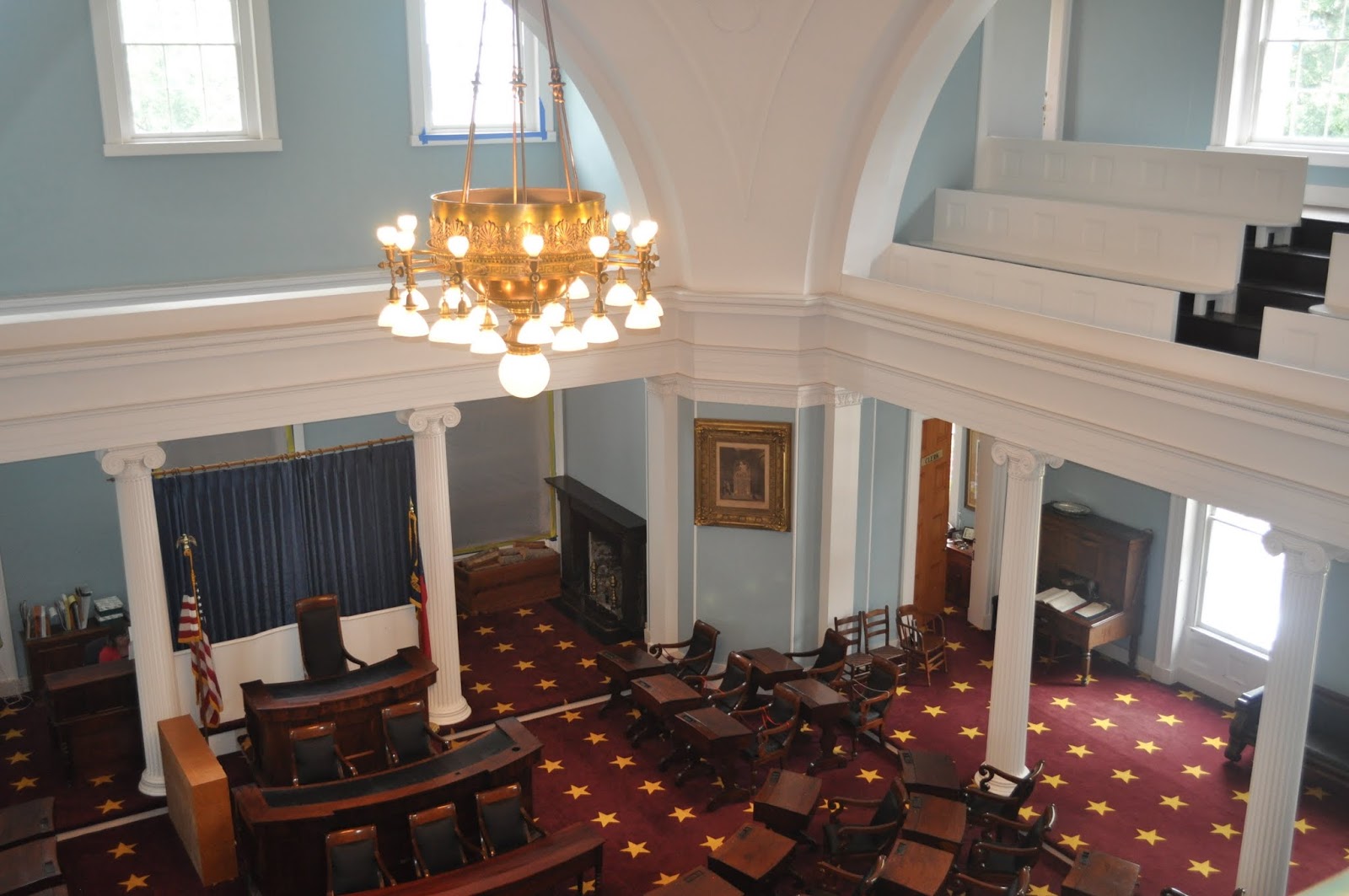
Our last post is short - The North Carolina State Capitol in Raleigh,North Carolina. The capitol building was completed in 1840 at a cost of $533,000 (3 times the state gross income at the time). Included in the capitol building is Antonio Canova's statue of George Washington (Not your typical George Washington Statue for sure). We also visited within the capitol the General Assembly, The State Legislature, the State Library and the State Geologist's office.  Compared to the many capitols we have visited, this one was somewhat simple.  That said, we were still glad to have had the opportunity to visit it and we had an incredible Creole lunch close by.

North Carolina State Capitol
Statue of George Washington by Canova
North Carolina State Capitol
General Assembly
North Carolina State Capitol
State Library
North Carolina State Capitol
State Legislature
North Carolina State Capitol
State Geologist's office
North Carolina State Capitol